Dharmendra Pradhan Resigns as Education Minister, Handing CJP Protesters Their Biggest Demand
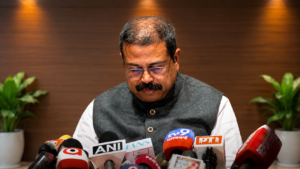
Union Education Minister Dharmendra Pradhan has resigned, meeting the single demand that has anchored a month of youth-led protests in Delhi. "I have sent my resignation to Prime Minister Narendra Modi," Pradhan said on Saturday, announcing the move on X.
The Timing Wasn't an Accident
Pradhan posted his resignation just hours before a third round of talks was scheduled between the government and leaders of the Cockroach Janta Party, the movement that has occupied Delhi's Parliament Street since organizing around anger over the NEET-UG paper leak. The announcement also landed the same day police fired tear gas to disperse protesters at the site, a jarring split-screen of concession and confrontation playing out within hours of each other.
In his letter to Modi, Pradhan said the decision was guided by the need to safeguard students' interests and to ensure the ongoing controversy did not further damage their future, framing his exit as being in service of the same students who had spent weeks demanding it.
A Reversal From the Government
The resignation marks a notable turnaround. Just days earlier, government officials had publicly rejected calls for Pradhan to step down, insisting he would retain the education portfolio even as Modi offered his first direct concession to protesters, a pledge to set up fast-track courts for paper-leak cases. CJP spokespeople dismissed that announcement at the time as a distraction from the minister they actually wanted gone. Pradhan's resignation removes that argument entirely.
What Led Here
The protests trace back to the NEET-UG medical entrance exam, cancelled in May after a leaked guess paper was found circulating before more than 2.2 million students sat the test. What began as anger over a single exam grew into a broader movement under the Cockroach Janta Party banner, drawing its name from a Chief Justice's remark comparing unemployed youth to cockroaches, and gaining national weight after education activist Sonam Wangchuk's 26-day hunger strike at the protest site ended with police hospitalizing him over health concerns.
At least 12 students are reported to have died by suicide since the exam's cancellation, a toll that hardened the protests from a policy dispute into something closer to a reckoning over accountability.
What's Still Unresolved
Pradhan's resignation answers one demand, but not all of them. The government has not yet named a successor, and CJP's other asks remain on the table: compensation of 10 million rupees for each family that lost a child to suicide, and a guarantee that no cases will be filed against people who protested peacefully. Both were expected to dominate the talks scheduled for the same day Pradhan stepped down.
For a movement that started online as satire and grew into the most sustained challenge to Modi's government from India's youth in years, forcing out a sitting Union minister is a rare, concrete win, and likely to embolden protesters still camped at Jantar Mantar over everything they haven't gotten yet.
Why the Government Reversed Itself
The turnaround is the most striking part. Days before the resignation, officials briefed that Pradhan would stay and that there was no question of him stepping down. Modi's own first concession, a pledge of fast-track courts and a new law against paper leaks, was framed as a substitute for a resignation rather than a step toward one.
What appears to have changed the calculation was scale and duration. The agitation had held Parliament Street for a month, shut 18 metro stations, spread to Mumbai, Bengaluru, Pune and Patna, prompted a Bihar bandh, and drawn diaspora rallies. A dispute the government had treated as containable had become the defining political story of the season.
What the Resignation Does Not Resolve
A minister leaving addresses accountability, not cause. The National Testing Agency, whose restructuring was central to protester demands, remains as it was. The CBI investigation into the leak network is unfinished. And more than 2.2 million candidates still need the examination rerun, with the timetable for that unclear.
The compensation commitment and the assurance against prosecuting protesters were settled separately, in talks that followed the resignation rather than preceding it.
The Precedent It Sets
An online movement with no party machinery, no established leadership structure and no electoral presence forced a Union minister out of office within roughly two months of organising. That has few recent parallels in Indian politics.
Whether it becomes a template depends on conditions that may not repeat: a grievance with a clearly identifiable minister, a sympathetic and widely felt cause, and a government facing an electoral calendar. Movements without those advantages have sustained far longer agitations to considerably less effect.