Quantum Computing, Explained Without the Jargon
Quantum computing gets described in two extremes: either it's going to break all encryption and cure every disease, or it's an overhyped science project decades from mattering. The truth sits in between, and it starts with understanding what a quantum computer actually does differently.
The Basic Idea
A regular computer stores information as bits, each one a firm 0 or 1. A quantum computer uses qubits, which can exist in a mix of states at once and can be linked together in ways that let the machine explore many possible answers simultaneously rather than checking them one at a time. For certain kinds of problems, that's an enormous shortcut. For most everyday computing, it offers no advantage at all.
What It's Actually Good For
Quantum computers aren't faster general-purpose computers, they're specialists. They show real promise for simulating molecules and chemical reactions, which could speed up drug and materials discovery, for optimization problems like routing and logistics at massive scale, and for certain types of cryptography, both breaking older methods and building new, quantum-resistant ones.
Why It's Not Here Yet
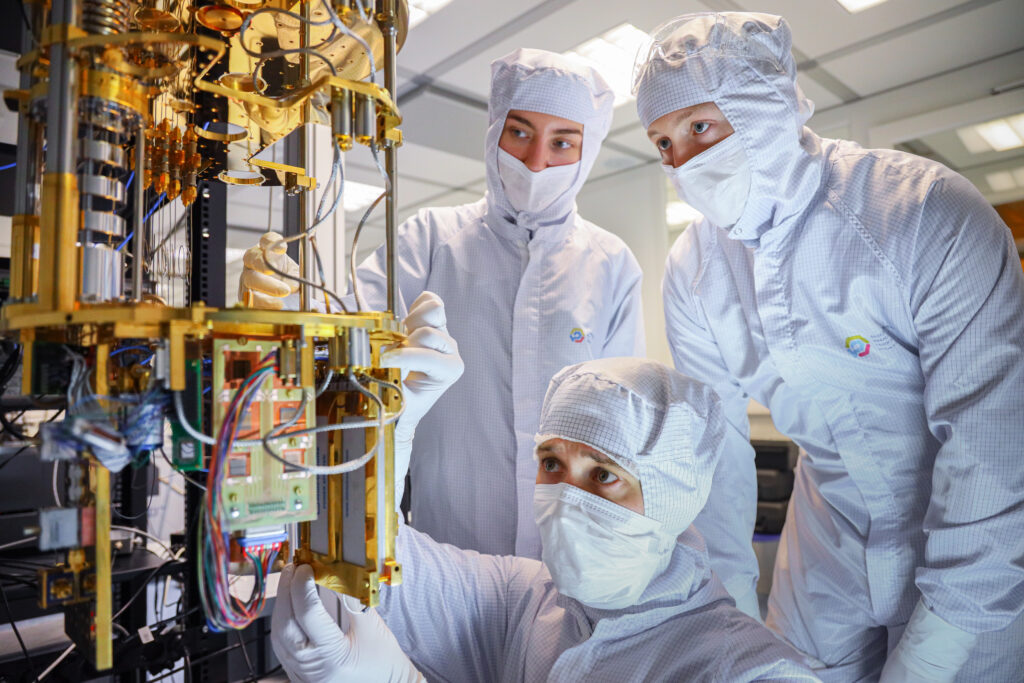
Qubits are extremely fragile. They lose their quantum state from the slightest vibration, temperature change, or electromagnetic interference, a problem called decoherence. Current machines need to be cooled close to absolute zero and still produce errors that require heavy correction. Building a machine with enough stable, error-corrected qubits to outperform classical computers on useful problems remains the central challenge.
Where Things Stand
Several labs and companies have demonstrated quantum computers outperforming classical ones on narrow, largely artificial benchmarks. Practical, real-world advantage on problems businesses actually care about is still likely years away, but steady progress on error correction is what most researchers point to as the real signal to watch, more than any single headline demo.
Why a Qubit Is Not Just a Faster Bit
The common explanation, that a qubit is both 0 and 1 at once, is close enough to be memorable and wrong enough to mislead. A qubit holds a combination of both states, but you cannot read that combination out. Measure it and you get a single 0 or 1, with probabilities determined by the combination. All the advantage has to be extracted before measurement collapses everything.
This is why quantum algorithms are difficult to design. The trick is arranging the computation so wrong answers cancel each other out and the right one is overwhelmingly likely when you finally look. Only a handful of problems are known to permit that arrangement.
The Problems It Genuinely Helps With
- Simulating molecules. Nature is quantum, so simulating chemistry on classical machines gets exponentially harder with molecule size. This is the application most researchers consider genuinely transformative, with implications for drug discovery, catalysts and battery chemistry.
- Certain optimisation problems. Promising but heavily caveated; classical methods keep improving and the practical advantage is contested.
- Breaking specific cryptography. A sufficiently large quantum computer could break the public-key encryption securing much of the internet. This is why post-quantum cryptography standards are being deployed now, well before such a machine exists.
What It Will Not Do
Quantum computers will not make spreadsheets faster, run websites, or improve your laptop. For the overwhelming majority of computing tasks they offer no advantage whatsoever and are considerably worse. They are specialised co-processors for a narrow class of problems, not successors to the machines we use.
The Error Problem
Qubits are extraordinarily fragile. Vibration, stray electromagnetic fields and temperature changes all destroy the quantum state, a process called decoherence. Current machines operate near absolute zero and still produce errors constantly.
The answer is error correction: spreading one reliable logical qubit across many physical ones so errors can be detected and fixed. The overhead is brutal, potentially a thousand physical qubits per logical one. This is why raw qubit counts in press releases mean less than they appear to.
What to Watch Instead
Ignore qubit counts. The meaningful signals are error rates per operation, how long coherence lasts, and whether error-corrected logical qubits are being demonstrated at all. Progress on those determines whether useful quantum computing arrives in years or decades, and honest researchers disagree about which.